
What I Learned from Watching a Man Decide, in Real Time, to Become Someone Else's Legend
I'm still sitting here. The screen went dark three minutes ago and I haven't moved. Just me and glowing notification icons on my phone and this weird pressure in my chest that feels adjacent to grief but isn't grief exactly.¹ More like recognition. The kind you get when you see something you didn't know you needed to see and now can't unsee.
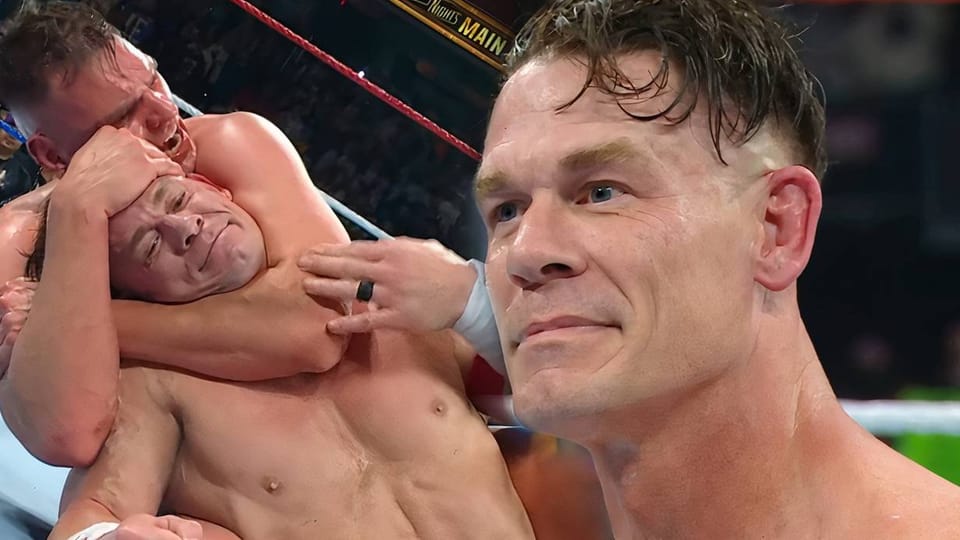
John Cena just retired from wrestling. Tapped out to someone named GUNTHER at Saturday Night's Main Event, ending a 23-year career in front of thousands of people who came expecting... something else. Not this. They came for triumph, for vindication, for the narrative resolution we've all been trained to expect. They got something harder to process instead.
What keeps replaying in my head is the moment itself. Cena's caught in a submission hold, GUNTHER wrenching his arm at an angle that looks genuinely painful even through the choreographed violence. The camera catches Cena's face and it's not what you'd expect. Not pain (though there's probably some of that). Not determination (though he's built a career on projecting exactly that quality). Something quieter. Almost peaceful. He's already decided. You can see it. The face of someone who's found the exact right ending to his story. And that ending happens to involve losing.²
And then the tap. Five times on GUNTHER's elbow. Except it's not the desperate slapping of someone in agony trying to escape. It's controlled. Deliberate. Almost polite. Like a golf tap. The gesture of someone giving a gift on their own terms. "Here. I'm giving you what you want. But understand: I'm choosing this."
That distinction matters.
There's losing because you have no other option, and then there's choosing to lose while you still have choices. The first is defeat. The second is something else entirely. Something our vocabulary doesn't quite have words for because we've built an entire culture around the premise that winning is always preferable to losing, that any voluntary loss is either weakness or delusion.³
But what if the best thing you can do with your story is hand it to someone else while you still have the power to make the handoff meaningful?
I've been thinking about this in the context of my own career. Not wrestling (obviously), but the same fundamental question: When do you step aside? How do you know when your continued presence is less valuable than your strategic absence? And once you know, how do you actually do it without either clinging desperately or disappearing bitterly?
The business literature talks about succession planning as though it's primarily a logistics problem. Identify potential successors. Develop them. Create transition timelines. Knowledge transfer protocols. All of which is necessary. But also completely insufficient because it treats the whole thing as a rational process when it's actually deeply emotional and ego-threatening.⁴
I've watched this play out badly more times than I can count. The executive who promises to step back but keeps undermining their successor. The professor who's supposed to be emeritus but still shows up at every meeting to explain why the new approach won't work. The founder who brings in a CEO but can't let them actually make decisions. All of them convinced they're being helpful when what they're actually doing is protecting their own sense of relevance.⁵
And I get it. I'm not immune to this. I've found myself in a meeting where someone younger and frankly more talented than me suggested a different approach to a project I'd been leading for three years. My immediate internal reaction was defensiveness disguised as concern. "That's interesting but have they considered X?" Translation: "I'm not ready to admit they might be better at this than I am."
The ego doesn't want to be succeeded. The ego wants to be permanent. And most of us are so thoroughly identified with our egos (the constructed story of who we are, what we've achieved, why we matter) that the idea of deliberately diminishing that story feels like self-annihilation.⁶
But here's what I'm realizing watching Cena's face in that submission hold: it's not self-annihilation. It's role-recognition. Understanding that your value in this chapter of the story might be different from your value in the last chapter. That leadership in year twenty-three looks different from leadership in year three. That sometimes the most important thing you can do is create space.
The Stoics talked about this in terms of duty aligned with nature. Marcus Aurelius, who ran an empire while trying to stay philosophically grounded, spent a lot of his Meditations reminding himself that his preferences were ultimately irrelevant to what the situation required. Accept your role. Do what needs doing. Stop confusing your desires with cosmic necessity.⁷
The irony is that Marcus was terrible at the specific thing Cena just demonstrated. He chose his biological son Commodus as successor, breaking the adoptive tradition that had given Rome its best emperors. Commodus turned out to be one of Rome's worst emperors.⁸ So even the philosopher-emperor couldn't quite manage voluntary succession done right. Which should tell us something about how difficult this actually is.
What makes it difficult (beyond the obvious ego investment) is the timing problem. Step aside too early and you waste your remaining capacity to contribute. Too late and you're the person everyone wishes would retire but won't. The sweet spot is narrow and requires a self-awareness most of us will never develop because we're too busy performing competence to honestly assess our own obsolescence.
Cena found that sweet spot. Still relevant enough that his loss creates narrative weight. Still skilled enough that it's clearly a choice rather than inevitable decline. The tap happens at precisely the moment where it means something.
I think about this in terms of specific professional transitions I've witnessed. The best one I ever saw was a director at my company who spent eighteen months deliberately building up his replacement. Not just training her on processes (though he did that). But actively creating opportunities for her to lead. Stepping back in meetings so she could step forward. Redirecting credit. Making it increasingly clear to everyone that she was the future and he was just the bridge.⁹
When he finally announced his transition to an advisory role, nobody was surprised. He'd already done the work of succession. The formal change was just paperwork. And the company didn't miss a beat because he'd prioritized continuity over his own centrality.
Compare that to a different executive I worked with who announced retirement, then spent the next year second-guessing every decision his successor made. Showing up uninvited to meetings. Sending "just some thoughts" emails that were territorial boundary-marking. He couldn't let go because he'd never separated his identity from his role. Without the title, he didn't know who he was.¹⁰
This identity-role fusion is the real obstacle. As long as you believe you are your job (or your craft, or your expertise, or whatever domain you've achieved mastery in), any diminishment of that role feels like personal diminishment. Which means you'll fight succession even when you know intellectually that it's time.
The work of stepping aside well starts long before the actual step. It starts with building an identity that's larger than any single role. With cultivating interests and relationships and sources of meaning that exist independent of your professional status. With practicing (and this is harder than it sounds) not being the most important person in the room.¹¹
I'm not good at this yet. I still get a hit of satisfaction from being the person people come to for answers. From being known for specific expertise. From the small ways I've made myself difficult to replace. All of which might be fine for now but sets me up to be the person who can't let go when the time comes.
What would it look like to start preparing now for an eventual succession I can't even imagine yet? What small practices could I adopt that would make the eventual transition less identity-threatening?
Maybe it looks like actively developing potential successors even when I'm nowhere near ready to step aside. Finding people who are talented and deliberately creating space for them to be visible. Redirecting opportunities. Making introductions. The kind of mentorship that's actually about the mentee rather than about my ego-gratification at being the wise elder.¹²
Maybe it means diversifying my sense of competence. Building skills and interests in domains where I'm not the expert, where I'm comfortable being mediocre or even struggling. Because if your entire self-worth is tied to being excellent at one thing, losing that one thing becomes unbearable.
Maybe it's as simple as practicing saying "I don't know" more often. Or "let me think about that" instead of immediately providing an answer. Small ways of making myself less central to every decision, less necessary to every outcome.¹³
The Buddhist concept of anatta or non-self points toward something useful here.¹⁴ The idea that the fixed, permanent self you think you are is actually just a process. A continuous flow of moments, sensations, thoughts, none of which individually constitute a stable "you." Which sounds abstract until you try applying it to career transitions. If there's no permanent "me" that needs protecting, then succession becomes less threatening. It's just different configurations of the same continuous process.
But I don't want to make this too philosophical because the practical question is urgent: What does good succession actually look like in the day-to-day? How do you build the conditions for it?
It starts with honest assessment. Are you still the best person for this role? Not "are you competent" but "are you the best option available?" Because continued competence isn't the same as optimal fit. You might be perfectly capable of continuing while someone else would be better positioned for what comes next.
It continues with active development of alternatives. Who could do your job if you weren't there? If nobody could, you haven't built a sustainable system. You've built a dependency. And dependencies feel good (you're needed!) but they're actually failures of leadership.
It requires creating visibility for potential successors. Bringing them into important meetings. Letting them lead initiatives. Giving them credit. This is harder than it sounds because it means deliberately diminishing your own visibility. Stepping back while you still have the option to step forward.¹⁵
And eventually it culminates in the decision itself. The recognition that your time in this role is complete and the dignified execution of your exit. Which brings us back to John Cena's tap out. The choice made with clarity. The gift given on your own terms.
What strikes me rewatching that moment (and I've rewatched it several times now) is the absence of hesitation. There's no internal debate visible on Cena's face. No last-second reconsideration. Just recognition that this is the moment followed immediately by action. Five polite taps. Done.
That kind of clarity only comes from already having done the internal work. From having wrestled with (pun intended) the ego's resistance and arrived at a different conclusion. From understanding that your legacy isn't your final match. It's what you make possible for the matches that come after.
I'm nowhere near that clarity yet. But I'm also aware now (in a way I wasn't before watching this) that the question isn't whether I'll eventually need to step aside but whether I'll do it well. Whether I'll recognize my moment. Whether I'll have the self-awareness to see when my continued presence serves my ego more than it serves the work.
Professional maturity is not about achieving more. It's about recognizing when achievement requires your absence more than your presence. When the best contribution you can make is creating space for someone else's contribution. When winning means losing in a way that makes someone else's victory possible.
There's video of GUNTHER after the match looking genuinely overwhelmed. Not just performing for cameras but actually processing what just happened. That's what it looks like to receive someone's legacy deliberately handed to you rather than seized. That's the gift Cena gave him: not just a win, but a meaningful win. A win with weight.
The screen is off now. But I'm still thinking about that tap. About the specific courage it takes to make that gesture while you still have other options. About how the final measure of a career might not be its achievements but its succession. Whether you went out in a way that made more room for the people coming up behind you.
And I keep rehearsing my own eventual tap. Whenever it comes. However it comes. Whether I’ll have the clarity to see it coming and the discipline to execute it clean. Whether I’ll recognize the moment where the best thing I can do is give someone else what they want. On my terms. With that same polite, controlled tap that says: here, take this, I’m choosing to give it to you.
Except-and this kills me-the part of me that loves this ending is also the part of me that wants one last clean image of myself. The ego in a blazer, calling itself generosity. Because the real generous ending isn’t the one where you hand it over like a gift.
It’s the one where you leave, and nothing pauses to mark it.
¹ This is the kind of emotion I never learned proper names for because our emotional vocabulary is surprisingly limited once you get past the basic six or seven. Grief, joy, anger, fear, disgust, surprise. After that it's all compound emotions and approximations. What's the word for "sad that something ended perfectly"? ↩︎
² The expression reminded me oddly of the family dog right before we put her down. Not morbid, just factual. She looked at me with this expression of complete acceptance, like "Oh, this is what's happening now. Okay." Animals sometimes have more grace about endings than humans do. ↩︎
³ American culture in particular has a pathological relationship with winning. We've built an entire mythology around triumph, comeback stories, refusing to quit. Which is fine when it serves genuine resilience but toxic when it prevents people from recognizing when continuation is just stubborn self-interest. ↩︎
⁴ The literature on succession planning tends to be written by HR professionals and consultants who understand systems but maybe underestimate the psychological resistance involved. It's not that people don't know they should develop successors. It's that actually doing it requires confronting your own eventual obsolescence, which most of us would prefer to avoid. ↩︎
⁵ The worst version of this I ever witnessed was a CEO who brought in a successor, announced his transition, then spent two years systematically undermining every major decision until the successor quit and the board asked the original CEO to come back. He claimed vindication. Everyone else just saw a man who couldn't let go and destroyed something rather than release control. ↩︎
⁶ This is treacherous philosophical territory and I'm not qualified to navigate it properly, but the basic distinction between "ego" (constructed self-identity) and whatever lies beneath that construction is common to multiple psychological traditions. The self you think you are is less solid than it feels. ↩︎
⁷ Marcus Aurelius never intended his Meditations to be published. They were private notes to himself, reminders about how to think and act in accordance with Stoic philosophy. Which makes them more honest than most philosophical texts because he wasn't performing for an audience. Just trying to get himself to do the right thing. ↩︎
⁸ The Commodus situation is more complicated than the usual telling. Marcus didn't simply choose his biological son over a better candidate. By the time the decision was made, Marcus had lost his co-emperor (Lucius Verus) and all but one of his sons. His general Pompeianus refused to become Caesar, possibly fearing it would trigger civil war. Marcus already faced one civil war in 175 CE, which made him rush Commodus through the stages to become co-emperor at age fourteen. The calculation appears to have been that a mediocre emperor was preferable to civil war, which could fragment the entire empire. Sidelining Commodus would have been a death sentence for his own son and likely sparked exactly the conflict Marcus was trying to avoid. So even the philosopher-emperor, faced with impossible choices and political constraints, couldn't execute the kind of clean succession Cena just demonstrated. Which suggests that stepping aside well requires not just wisdom but also circumstances that permit it. ↩︎
⁹ This director is now consulting part-time and spending the rest of his time building furniture. He told me he's happier than he's been in years because he's no longer responsible for everything. The transition worked because he'd already done the identity work of separating who he was from what he did professionally. ↩︎
¹⁰ I'm specifically not naming these people because the point isn't to shame anyone. We're all capable of being either example depending on whether we've done the internal work of building an identity larger than our role. The second executive eventually figured it out but not before causing real damage to the organization and to his own relationships. ↩︎
¹¹ There's research in organizational psychology about the difference between job involvement (caring about doing your work well) and job identity (believing you are your work). High involvement with low identity is the sweet spot. You care deeply about quality without your entire sense of self depending on occupying that particular role. Easy to say, difficult to achieve. ↩︎
¹² Most mentorship fails because it's actually about the mentor's need to feel valuable rather than the mentee's development. Real mentorship requires genuine generosity. Creating opportunities for someone else to shine even when it means you're less visible. This is why good mentors are relatively rare. ↩︎
¹³ I learned this accidentally during a period where I was genuinely overwhelmed and had to delegate more than I normally would. Discovered that things ran fine without me being involved in every decision. Which was both humbling and liberating. Humbling because I wasn't as necessary as I thought. Liberating because it meant I could let go without everything falling apart. ↩︎
¹⁴ The Buddhist concept of anatta is one of the three marks of existence in Buddhist philosophy, along with dukkha (suffering) and anicca (impermanence). It points to the idea that there's no permanent, unchanging essence we can call "me." Just continuous process. Which has practical implications for how we think about career transitions and identity. ↩︎
¹⁵ Creating visibility for others while reducing your own is counterintuitive to everything we're taught about career advancement. But if your goal is sustainable excellence in your field or organization rather than personal glory, it's the most important work you can do. The question is whether you can genuinely commit to that goal or whether your ego will sabotage it. ↩︎